Time Treks
- Grades 1–5
- History
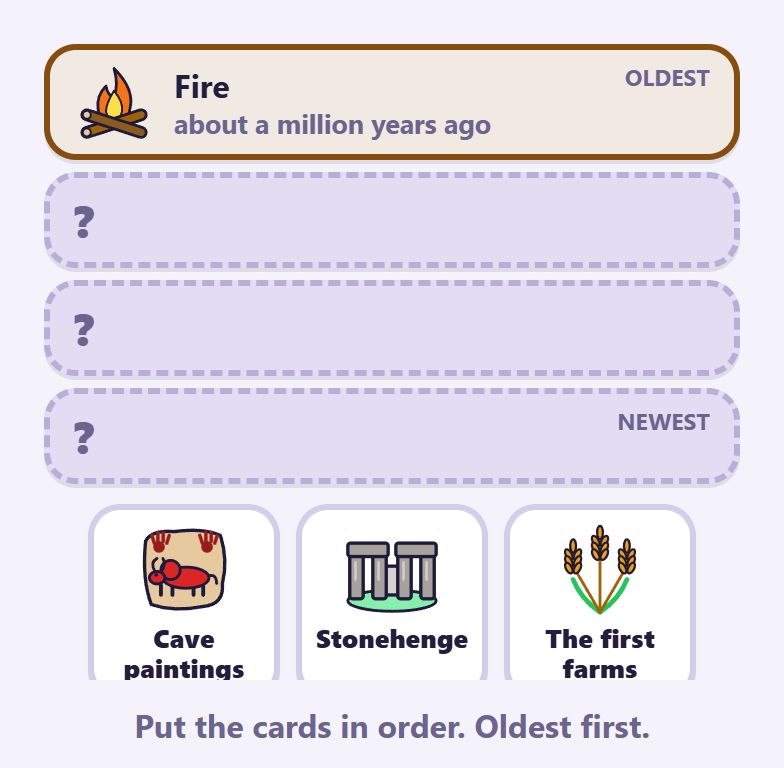
Time Treks sends your child through history to return a museum's lost treasures: put events in order, spot what doesn't belong in a cave or a castle, work out who is who from clues, and match old things to today's. Every level teaches what it needs first, facts come from a reviewed bank, and it's all read aloud.
Free trial: 3 days with the first 25 levels of every game. No card needed.
What it teaches
- Put events in order from oldest to newest, like a timeline
- Compare life long ago with life today
- Spot what does not belong in a scene from the past
- Use clues to work out who a person from the past was
- Sort objects (artifacts) by the people and time they came from
- Learn about early civilizations such as Egypt, Greece, Rome, China, India and the Maya
- Recognize real people and events from history, from explorers and inventors to American leaders
- See how inventions and ideas from long ago connect to the things we use today
Chapter by chapter
- First People: Sequencing events and comparing the past with today
- Ancient Egypt & Mesopotamia: Learning how early civilizations built, wrote and farmed, and sorting their artifacts
- Ancient Greece & Rome: Ordering events and linking ancient ideas, like democracy and aqueducts, to today
- Ancient Asia: Matching inventions and people from ancient China, India and Japan to the problems they solved
- Castles & Kingdoms: Comparing how people lived in kingdoms and cultures around the world
- Explorers & Inventors: Putting voyages and inventions in order and telling who did what
- Building America: Following American history in order and recognizing key people and events
- Modern Marvels: Connecting inventors and inventions to the way we live now
Standards
TEKS (Texas)
TEKS SS 1.17(A)use a simple timeline to distinguish among past, present, and future;TEKS SS 2.15(B)identify different kinds of historical sources and artifacts and explain how they can be used to study the past;TEKS SS 2.16(C)create and interpret timelines for events in the past and present;TEKS SS 3.15(B)create and interpret timelines;TEKS SS 1.2(A)identify contributions of historical figures, including Sam Houston, George Washington, Abraham Lincoln, and Martin Luther King Jr., who have influenced the state and nation;TEKS SS 1.15(C)identify the contributions of scientists and inventors such as Alexander Graham Bell, Thomas Edison, and Garrett Morgan.TEKS SS 2.16(A)describe the order of events by using designations of time periods such as historical and present times;TEKS SS 3.1(A)describe how individuals, events, and ideas have changed communities, past and present;TEKS SS 5.1(A)explain when, where, and why groups of people explored, colonized, and settled in the United States, including the search for religious freedom and economic gain;TEKS SS 5.4(C)identify significant events and concepts associated with U.S. territorial expansion, including the Louisiana Purchase, the expedition of Lewis and Clark, and Manifest Destiny;TEKS SS 5.22(A)identify the accomplishments of notable individuals in the fields of science and technology such as Benjamin Franklin, Eli Whitney, John Deere, Thomas Edison, Alexander Graham Bell, George Washington Carver, the Wright Brothers, and Neil Armstrong;
Florida NGSSS (science / social studies) & Florida Computer Science
SS.1.A.2.1Understand that history tells the story of people and events of other times and places.SS.1.A.2.2Compare life now with life in the past.SS.1.A.3.1Use terms related to time to sequentially order events that have occurred in school, home, or community.SS.2.A.2.1Recognize that Native Americans were the first inhabitants in North America.SS.2.A.2.6Discuss the importance of Ellis Island and the Statue of Liberty to immigration from 1892 - 1954.SS.5.A.1.2Utilize timelines to identify and discuss American History time periods.SS.5.A.2.1Compare cultural aspects of ancient American civilizations (e.g., Aztecs, Mayas, Mound Builders, Anasazi, Inuit).SS.5.A.3.1Describe technological developments that shaped European exploration.SS.5.A.3.2Investigate (nationality, sponsoring country, motives, dates and routes of travel, accomplishments) the European explorers.SS.5.A.4.1Identify the economic, political and socio-cultural motivation for colonial settlement.SS.5.A.6.2Identify roles and contributions of significant people during the period of westward expansion.SS.5.A.6.4Explain the importance of the explorations west of the Mississippi River.
C3 Framework (social studies)
D2.His.1.K-2Create a chronological sequence of multiple events.D2.His.1.3-5Create and use a chronological sequence of related events to compare developments that happened at the same time.D2.His.2.K-2Compare life in the past to life today.D2.His.2.3-5Compare life in specific historical time periods to life today.
One of 25 games in Solveville
No ads, no in-app purchases, no paid boosters. About Solveville