Memory Pairs
- Grades K–2
- Memory
- Reading
- Math
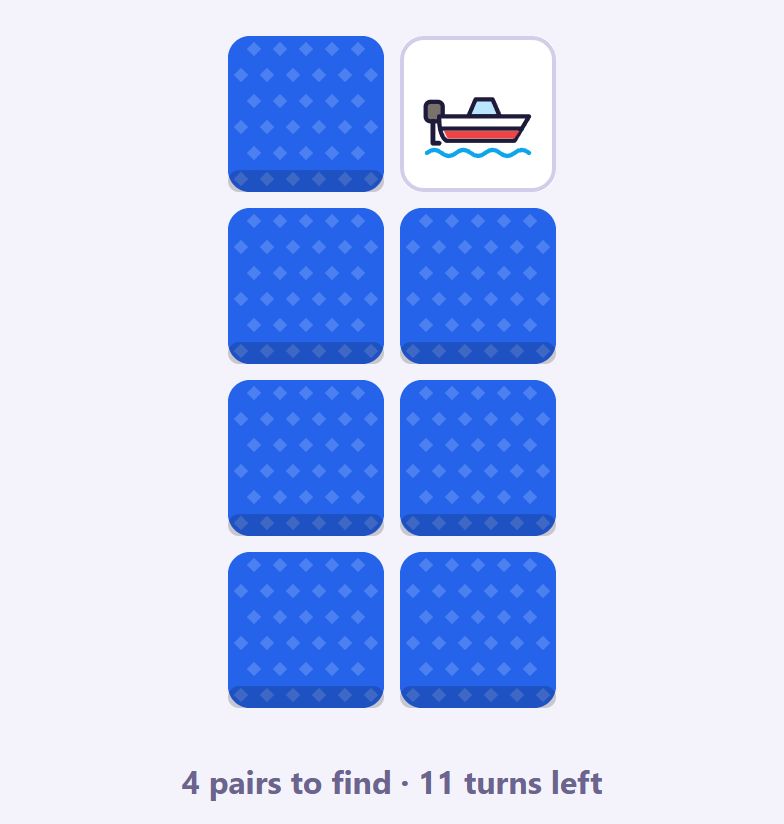
Memory Pairs is the classic turn-two-cards matching game with a twist: later decks match a picture to its word, a number to its dots, or a sum to its answer. Every board can be cleared by remembering well — the turn budget just keeps it a game.
Free trial: 3 days with the first 25 levels of every game. No card needed.
What it teaches
- Memory and concentration: remember where each card was
- Match pictures to words and read sight words
- See how many dots without counting (subitizing)
- Match a sum to its answer (3 + 4 ↔ 7)
Enrichment: matching two identical pictures isn't a school standard. It builds visual memory and concentration — remembering where each card was and choosing which to flip next — the same working memory kids use to hold a sentence while reading or a number while doing mental math.
Standards
Common Core (Math / ELA)
CCSS.ELA-Literacy.RF.K.3.cRead common high-frequency words by sight.CCSS.ELA-Literacy.RF.1.3.gRecognize and read grade-appropriate irregularly spelled words.CCSS.Math.Content.K.CC.B.5Count to answer "how many?" questions about as many as 20 things …CCSS.Math.Content.1.OA.C.6Add and subtract within 20, demonstrating fluency for addition and subtraction within 10.
TEKS (Texas)
TEKS ELAR 1.2(B)(vi)Identifying and reading at least 100 high-frequency words from a research-based list.TEKS K.2DRecognize instantly the quantity of a small group of objects in organized and random arrangements.TEKS 2.4ARecall basic facts to add and subtract within 20 with automaticity.
B.E.S.T. (Florida math & ELA)
ELA.K.F.1.4Recognize and read with automaticity grade-level high frequency words.MA.K.NSO.1.1Given a group of up to 20 objects, count the number of objects in that group … State the number of objects in a rearrangement of that group without recounting.MA.1.NSO.2.1Recall addition facts with sums to 10 and related subtraction facts with automaticity.
One of 25 games in Solveville
No ads, no in-app purchases, no paid boosters. About Solveville