Sort It
- Grades K–3
- Science
- Reading
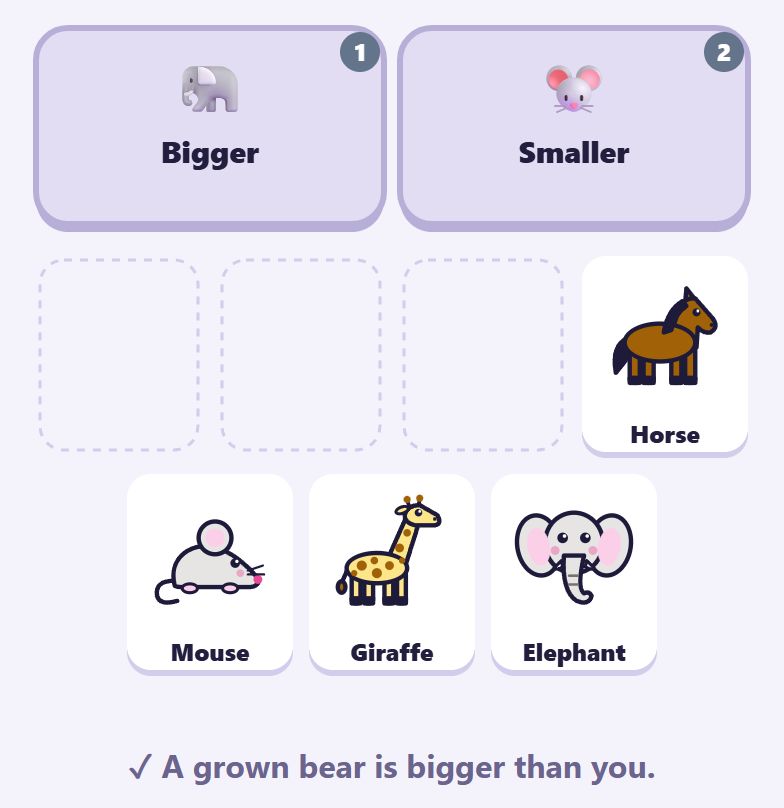
Sort It has your child drag pictures into the right groups — living or not, land or sea, mammal or bird — and every card explains why it belongs.
Free trial: 3 days with the first 25 levels of every game. No card needed.
What it teaches
- Sort things into groups by what they have in common
- Living vs. nonliving; mammal, bird, fish and other animal groups
- Solid, liquid or gas (Science sort)
- Learn category words
Standards
Common Core (Math / ELA)
CCSS.ELA-Literacy.L.K.5.aSort common objects into categories (e.g., shapes, foods) to gain a sense of the concepts the categories represent.CCSS.ELA-Literacy.L.1.5.aSort words into categories (e.g., colors, clothing) to gain a sense of the concepts the categories represent.CCSS.ELA-Literacy.L.1.5.bDefine words by category and by one or more key attributes (e.g., a duck is a bird that swims).
TEKS (Texas)
TEKS Sci 1.12AClassify living and nonliving things based upon whether they have basic needs and produce young.TEKS Sci 3.6BDescribe and classify samples of matter as solids, liquids, and gases …TEKS ELAR 1.3(D)Identify and use words that name actions, directions, positions, sequences, categories, and locations.
B.E.S.T. (Florida math & ELA)
ELA.K.V.1.3Identify and sort common words into basic categories, relating vocabulary to background knowledge.
Florida NGSSS (science / social studies) & Florida Computer Science
SC.K.P.8.1Sort objects by observable properties, such as size, shape, color, temperature (hot or cold), weight (heavy or light) and texture.SC.1.L.14.3Differentiate between living and nonliving things.SC.2.P.8.2Identify objects and materials as solid, liquid, or gas.SC.3.L.15.1Classify animals into major groups (mammals, birds, reptiles, amphibians, fish, arthropods, vertebrates and invertebrates …) according to their physical characteristics and behaviors.
NGSS (science)
2-PS1-1Plan and conduct an investigation to describe and classify different kinds of materials by their observable properties.K-LS1-1Use observations to describe patterns of what plants and animals (including humans) need to survive.
One of 25 games in Solveville
No ads, no in-app purchases, no paid boosters. About Solveville